Hypothesis Testing Explained: A Beginner's Guide for Researchers
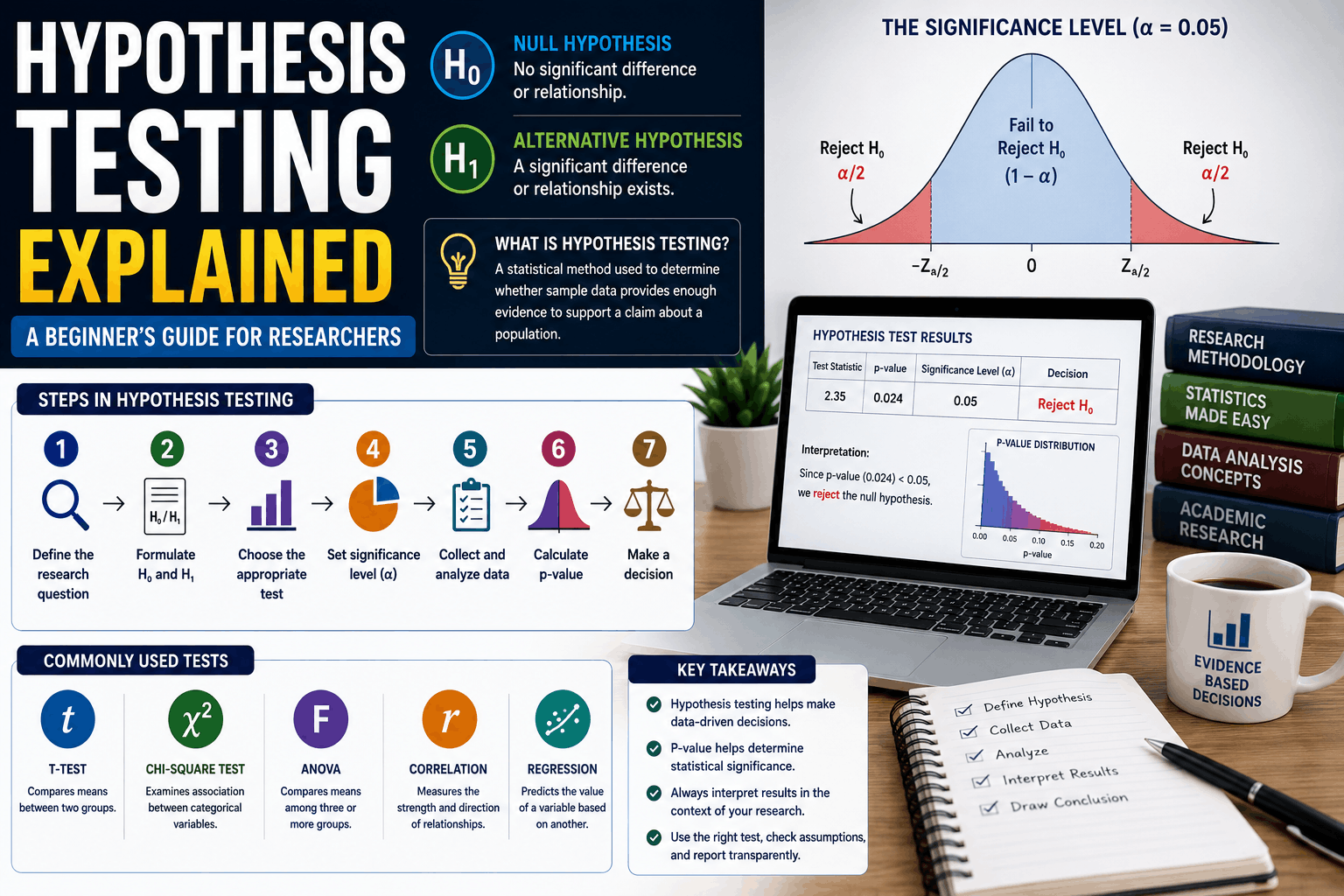
Hypothesis testing is a statistical method used to determine whether research findings support a specific claim or assumption. It helps researchers make evidence-based decisions by analyzing sample data and determining whether observed differences or relationships are statistically significant. From social sciences to healthcare and engineering, hypothesis testing is an essential component of academic research.
What Is a Hypothesis?
A hypothesis is a clear, testable statement that predicts the relationship between variables. Researchers develop hypotheses before collecting data and evaluate them using statistical methods.
Types of Hypotheses
- Null Hypothesis (H₀): Assumes there is no significant relationship or difference.
- Alternative Hypothesis (H₁): Suggests a significant relationship or difference exists.
Steps in Hypothesis Testing
- Define the research question.
- State the null and alternative hypotheses.
- Select the appropriate statistical test.
- Choose the significance level (commonly 0.05).
- Collect and analyze data.
- Calculate the p-value.
- Accept or reject the null hypothesis.
Understanding the P-Value
The p-value indicates the probability of obtaining the observed results if the null hypothesis is true. A p-value lower than the chosen significance level generally provides sufficient evidence to reject the null hypothesis.
Common Statistical Tests
- Independent t-test
- Paired t-test
- Chi-Square Test
- ANOVA
- Correlation Analysis
- Linear Regression
Best Practices
- Develop clear research hypotheses.
- Choose statistical tests appropriate for your data.
- Check assumptions before analysis.
- Interpret both statistical and practical significance.
- Report results transparently.
Common Mistakes
- Confusing statistical significance with practical importance.
- Using an inappropriate statistical test.
- Ignoring sample size requirements.
- Misinterpreting p-values.
- Drawing conclusions without checking assumptions.
Related Research Methodology Articles
- Historical Research Methods
- Action Research in Education
- Case Study Research Explained
- Focus Group Discussions in Research
- How to Create Effective Survey Questions
- Interview Methods in Qualitative Research
- Questionnaire Design Tips for Researchers
- Probability vs Non-Probability Sampling
- Sampling Techniques in Research
- Meta-Analysis in Research: A Beginner's Guide
- How to Conduct a Systematic Literature Review
- Types of Research Designs Explained
- Research Proposal Mistakes to Avoid
- Validity and Reliability in Research
- How to Ensure Research Accuracy
- Statistical Tools Every Researcher Should Know
- Basics of SPSS for Academic Research
- Introduction to R Programming for Researchers
- Using Excel for Research Data Analysis
Improve Your Research Impact
- Academic Research Visibility: Why It Matters for Researchers
- What Makes Research Discoverable Online?
- Strategies to Improve Academic Visibility in 2026
- How Researchers Can Increase Citation Counts in 2026
- How Academic Authors Can Build a Strong Research Profile
- Research Portfolio Development Tips (2026)
Conclusion
Hypothesis testing is a fundamental technique for evaluating research findings and drawing evidence-based conclusions. By understanding null and alternative hypotheses, selecting appropriate statistical tests, interpreting p-values correctly, and following sound research practices, researchers can improve the validity and credibility of their studies while producing results suitable for publication in reputable academic journals.