Writing the Discussion Section of a Research Paper
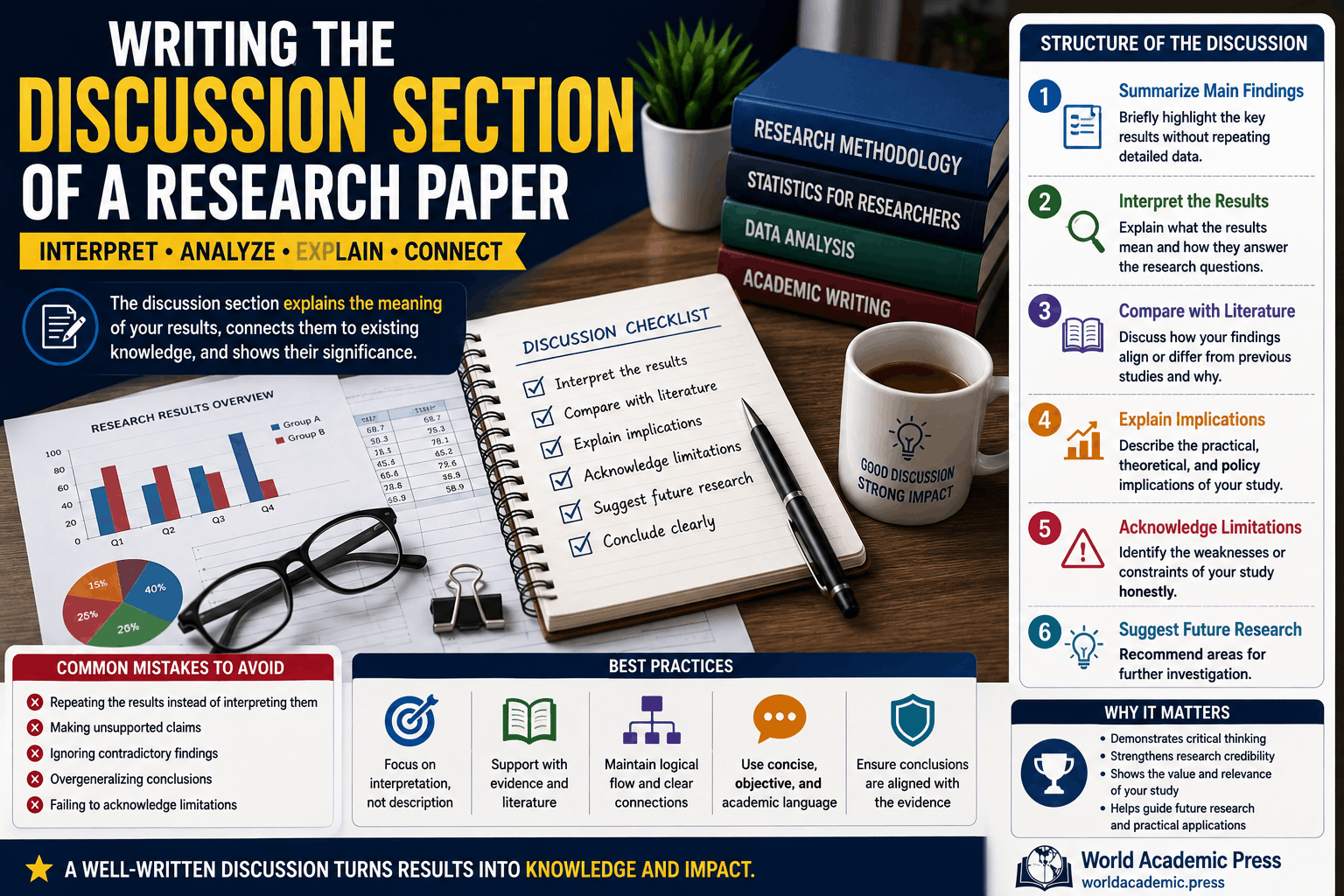
The discussion section is where researchers explain the meaning and importance of their findings. Rather than repeating the results, this section interprets the data, connects it to existing literature, discusses practical implications, and highlights the strengths and limitations of the study. A well-written discussion demonstrates critical thinking and shows how the research contributes to academic knowledge.
Purpose of the Discussion Section
- Interpret research findings.
- Answer the research questions.
- Compare results with previous studies.
- Explain theoretical and practical implications.
- Identify study limitations and future research opportunities.
How to Structure the Discussion
1. Summarize the Main Findings
Begin by briefly highlighting the most important results without repeating detailed statistics already presented in the results section.
2. Interpret the Results
Explain what the findings mean and whether they support the research objectives or hypotheses.
3. Compare with Previous Research
Discuss similarities and differences between your findings and existing literature while offering possible explanations.
4. Explain Practical Implications
Describe how the findings can influence practice, policy, education, healthcare, business, or future research.
5. Discuss Limitations
Acknowledge factors such as sample size, research design, measurement limitations, or data availability that may affect the findings.
6. Suggest Future Research
Recommend areas that future researchers can explore to build upon your study.
Common Mistakes to Avoid
- Repeating the results instead of interpreting them.
- Making unsupported claims.
- Ignoring contradictory findings.
- Overgeneralizing conclusions.
- Failing to acknowledge limitations.
Best Practices
- Focus on interpretation rather than description.
- Support arguments with published literature.
- Maintain a logical flow between paragraphs.
- Use clear and objective academic language.
- Ensure conclusions align with the presented evidence.
Related Research Methodology Articles
- Historical Research Methods
- Action Research in Education
- Case Study Research Explained
- Focus Group Discussions in Research
- How to Create Effective Survey Questions
- Interview Methods in Qualitative Research
- Questionnaire Design Tips for Researchers
- Probability vs Non-Probability Sampling
- Sampling Techniques in Research
- Meta-Analysis in Research: A Beginner's Guide
- How to Conduct a Systematic Literature Review
- Types of Research Designs Explained
- Research Proposal Mistakes to Avoid
- Validity and Reliability in Research
- How to Ensure Research Accuracy
- Statistical Tools Every Researcher Should Know
- Basics of SPSS for Academic Research
- Introduction to R Programming for Researchers
- Using Excel for Research Data Analysis
- Hypothesis Testing Explained
- Common Statistical Errors in Research
- How to Interpret Research Results
Improve Your Research Visibility
- Academic Research Visibility: Why It Matters for Researchers
- What Makes Research Discoverable Online?
- Strategies to Improve Academic Visibility in 2026
- How Researchers Can Increase Citation Counts in 2026
- How Academic Authors Can Build a Strong Research Profile
- Research Portfolio Development Tips (2026)
Conclusion
The discussion section transforms research findings into meaningful academic contributions. By interpreting results thoughtfully, comparing them with previous studies, acknowledging limitations, and identifying future research opportunities, researchers strengthen the impact and credibility of their work. A clear and balanced discussion not only enhances publication quality but also demonstrates the broader significance of the research.